Interview with the Vampire (1994): Immortality, Guilt, and the Cost of Forever
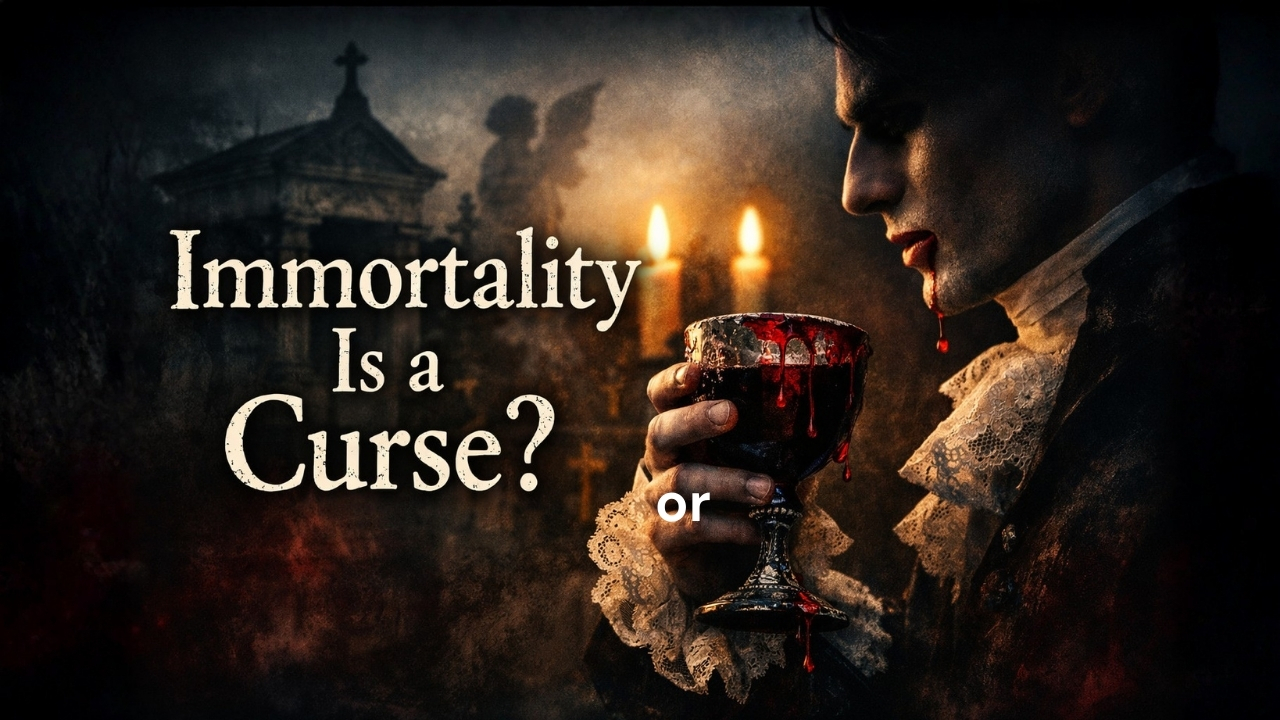
Interview with the Vampire (1994): Immortality, Guilt, and the Cost of Forever
Immortality sounds seductive.
Eternal youth. Endless time. Infinite experience.
But Interview with the Vampire (1994) asks a far more unsettling question:
What if forever isn’t freedom… but emotional imprisonment?
In this episode of Parallel Frequencies with Just Blane & Coco, we revisit Anne Rice’s gothic masterpiece and unpack why this film remains one of the most philosophically rich vampire stories ever adapted to
.
This isn’t a story about fangs.
It’s about regret that never fades.
It’s about guilt that never dies.
It’s about being stuck as version one of yourself — forever.
The Real Premise: Immortality as Existential Crisis
When Louis (Brad Pitt) is turned into a vampire by Lestat (Tom Cruise), the story doesn’t celebrate power.
It questions it.
Louis is not thrilled to become immortal. He’s haunted by it.
He feeds, but he feels.
He survives, but he grieves.
He exists, but he questions.
The film reframes vampirism not as dominance, but as moral dissonance.
Louis becomes the prototype for the tortured, introspective immortal — long before modern vampire dramas turned brooding into a genre staple.
He doesn’t fear death.
He fears what he’s becoming.
And that shift in perspective is what separates Interview with the Vampire from traditional horror.
Lestat: Charisma Masking Loneliness
Tom Cruise’s Lestat is magnetic.
He’s theatrical.
He’s seductive.
He’s dangerous.
But beneath the bravado lies something more fragile: isolation.
Lestat doesn’t create companions because he loves deeply.
He creates them because he fears being alone for eternity.
He wants:
An audience
A reflection
Someone to validate his existence
His relationship with Louis is less about partnership and more about emotional dependency.
And that tension drives the entire film.
Where Louis seeks meaning, Lestat seeks sensation.
That philosophical collision is the true battleground.
Claudia: The Film’s Most Devastating Horror
If Louis represents guilt and Lestat represents indulgence, Claudia represents tragedy.
Turned into a vampire as a child, Claudia is condemned to eternal adolescence.
Her body never matures.
Her autonomy never fully develops.
Her identity is frozen in place.
And that is terrifying.
Kirsten Dunst delivers a performance that still feels startling decades later. She plays ancient frustration inside a child’s frame.
Claudia isn’t simply angry.
She’s mourning a future she will never experience.
Her rage isn’t theatrical. It’s existential.
Imagine:
Watching yourself remain physically unchanged while your mind evolves.
Never being perceived as an adult.
Forever needing a guardian to navigate society.
Claudia’s storyline is the film’s most haunting metaphor: growth denied.
Why the Film Hits Harder as You Age
Watch this movie as a teenager, and it feels romantic.
Watch it in your thirties or forties, and it feels devastating.
Because the longer you live, the more you understand what it means to outgrow yourself.
We all evolve.
Version one of who you were at 18 isn’t who you are now.
Interview with the Vampire imagines the nightmare scenario where evolution stops.
Where regret lingers.
Where identity calcifies.
Where time stretches but healing does not.
That’s the real horror.
Not blood.
Stagnation.
The Queer Subtext That Made It a Cult Cornerstone
Even in 1994, the emotional intimacy between Louis and Lestat was unmistakable.
Jealousy.
Dependency.
Romantic tension.
While the film couldn’t be overt in its portrayal due to the era, the subtext was clear.
That layered dynamic contributed to the film’s enduring cult status. Audiences saw complexity. They saw coded longing. They saw a relationship that didn’t fit traditional molds.
Today’s AMC adaptation explores that subtext more explicitly.
But the emotional blueprint was already there.
And that’s part of why the film continues to resonate.
90s Gothic Aesthetic: Beautiful Sadness
Visually, Interview with the Vampire is drenched in atmosphere.
Candlelight.
Velvet.
Cemeteries.
Decay.
Opulence.
The film feels textured.
You can almost smell old books and spilled wine.
The 1990s were obsessed with beautiful sadness. This film embodies that era perfectly:
Slow-burning monologues
Emotional intensity
Dramatic pacing
Philosophical weight
There are no cheap jump scares.
Instead, dread marinates slowly.
And that patience gives the film its staying power.
Cultural Impact: Redefining the Vampire Genre
Before this film, vampires were largely monsters or camp icons.
After it, they became tragic figures.
The movie proved that horror could be:
Philosophical
Introspective
Emotionally layered
Morally complex
It opened the door for:
Brooding supernatural dramas
Prestige horror storytelling
Vampire narratives rooted in psychology
Anne Rice wrote the novel in 1976, but the 1994 adaptation cemented its mainstream cultural influence.
It demonstrated that monsters could be heartbreakingly human.
The Performance Legacy
It’s impossible to discuss this film without acknowledging the performances:
Brad Pitt as Louis: restrained, conflicted, sorrowful
Tom Cruise as Lestat: electric, chaotic, unforgettable
Kirsten Dunst as Claudia: emotionally devastating
There were doubts at the time about Cruise’s casting.
He silenced them.
There were risks in letting a child actor shoulder existential rage.
Dunst delivered.
Every major actor in the film went on to sustained success.
This wasn’t just star power.
It was aligned performance and theme.
Why Stories Like This Still Matter
In an era of fast content and quick dopamine hits, Interview with the Vampire demands patience.
It forces reflection.
It lingers.
That’s exactly the kind of storytelling we champion on Parallel Frequencies — conversations that explore the psychological undercurrents beneath pop culture.
And if you’re creating long-form conversations like this yourself, quality matters.
We record our remote episodes using Riverside for studio-level audio and video:
https://riverside.sjv.io/7aAMay
We turn long-form discussions into high-performing clips using Opus Pro:
https://www.opus.pro/pricing?via=5b5b73
And we host our podcast websites through Podpage, which simplifies everything from SEO to distribution:
https://www.podpage.com/account/signup/?via=just
Tools matter.
But depth matters more.
Final Thought: Read the Emotional Terms and Conditions
If a pale aristocrat offered you eternal life…
Would you ask what it costs?
Interview with the Vampire suggests the price is steep:
Eternal guilt
Permanent loneliness
Frozen identity
Unresolved grief
Immortality isn’t power.
It’s permanence.
And permanence without growth is a prison.
If you appreciate cinematic deep dives that go beyond surface-level commentary, subscribe to Parallel Frequencies with Just Blane & Coco.
Join the freqs.
And explore more conversations at:
🌊 https://www.ridethewave.media
Because immortality may last forever.
But community is what gives it meaning.

The Unsettling Genius of Bugonia