Podcast Trailers Gone Wild: Inside Just Blane’s Trailer Park
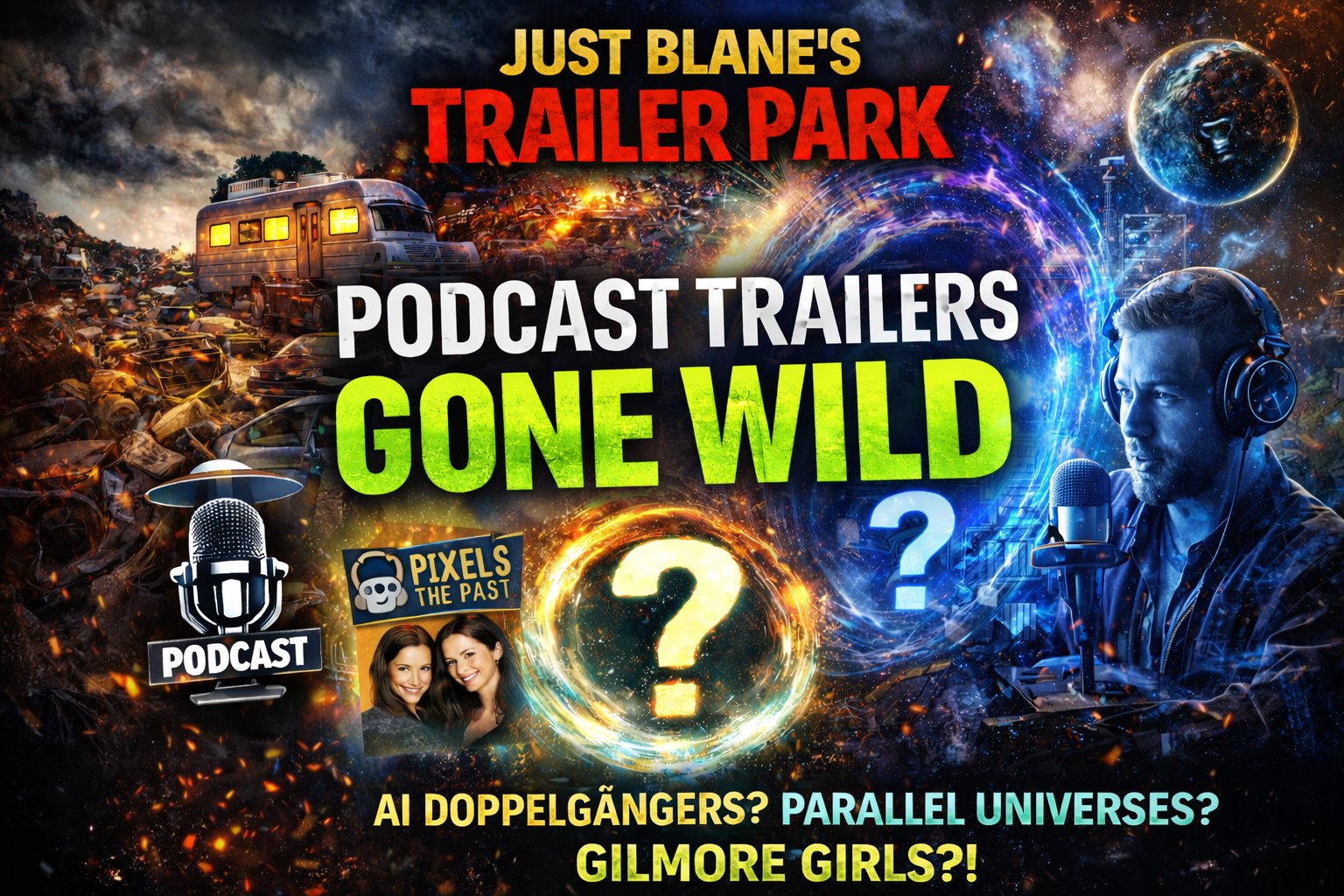
Podcast Trailers Gone Wild: Inside Just Blane’s Trailer Park
There’s a moment in every creative medium when the rules loosen, the guardrails fall away, and something unexpected rolls in from the edge of the map. In podcasting, that moment often arrives disguised as a trailer. Not the polished, corporate kind. The strange ones. The scrappy ones. The ones that feel like they were recorded in a garage, a comedy club, or possibly a parallel universe.
Welcome to Just Blane’s Trailer Park, a recurring segment on Parallel Frequencies where podcast trailers pull up, kick the dust off their boots, and show us what this medium is really capable of when it’s not trying to be perfect.
This episode isn’t just about podcast trailers. It’s about creativity, identity, fandom, nostalgia, and what happens when humans and AI start staring at each other through the same microphone.
The Trailer Park Philosophy: Weird Is the Point
The heart of Just Blane’s Trailer Park is simple: it’s okay to be weird.
Some of the most exciting creative breakthroughs don’t come from strategy decks or audience avatars. They come from people who gave themselves permission to sound different. To experiment. To try something that might not fit neatly into a category on Apple Podcasts.
That spirit shows up immediately in this episode, beginning with a celebration of underground comedy and unapologetic creativity. There’s something powerful about watching someone else lean fully into their voice. It unlocks something in the rest of us. Suddenly the question isn’t “Will this work?” but “What if it does?”
Podcast trailers are the purest expression of that energy. They’re short. They’re risky. And they often reveal more about a creator than a full episode ever could.
Pixels From the Past: Where History Meets Gaming Culture
One of the standout trailers featured in this episode is Pixels From the Past, a podcast built on a deceptively smart idea: tracing modern video game characters back to their historical inspirations.
At first glance, it sounds niche. Then you realize it’s genius.
Gaming culture and history rarely share the same conversation space, yet they’re deeply connected. Many of the villains, heroes, and archetypes we see on screen are modern remixes of real historical figures. Conquerors. Strategists. Mythic leaders. Monsters with familiar DNA.
This kind of concept does something special. It invites gamers into history and history buffs into gaming. It lowers the barrier to entry for both audiences. Suddenly, you don’t need to be an expert in either world to enjoy the show. Curiosity does the work for you.
That’s the mark of a strong podcast idea. It creates a bridge, not a gate.
Generation Gilmore Girls and the Power of Comfort Media
Then the tone shifts, gently, into something warmer.
Generation Gilmore Girls, a podcast from Connecticut Public, explores how a TV show that ended nearly two decades ago somehow became more relevant after it was over than when it was on the air.
If you lived through the early 2000s, you probably knew Gilmore Girls existed. You may not have watched it. You may have dismissed it. But during the streaming era, and especially during the isolation of the pandemic, the show found a second life as comfort television.
What this trailer captures beautifully is the emotional gravity of nostalgia. For many people, Gilmore Girls wasn’t just background noise. It became a companion during grief, illness, breakups, and major life transitions. That kind of connection doesn’t fade. It compounds.
The discussion around Generation Gilmore Girls opens up a larger truth: audiences don’t just love stories. They love how stories make them feel when they need them most.
And podcasting, at its best, taps into that same emotional frequency.
Rewatch Podcasts and the Long Tail of Fandom
The episode naturally drifts into a broader conversation about rewatch podcasts and fandom culture. Shows like Boy Meets World, The X-Files, Cheers, and countless others are finding new life through long-form conversations that unpack every episode, every character arc, every behind-the-scenes detail.
Why does this work?
Because fandom doesn’t expire.
People want context. They want reflection. They want to revisit stories with older eyes and different life experiences. Podcasts offer something TV never could: a space to slow down and talk about what those stories meant, not just what happened.
That’s a powerful reminder for creators. You don’t always need something new. Sometimes you need a new angle on something familiar.
When AI Enters the Trailer Park
Then things get strange. In the best way.
In this episode, Just Blane experiments with AI tools like ChatGPT and Sora, prompting them to create a podcast trailer for Parallel Frequencies. The result isn’t just impressive. It’s unsettling.
The AI doesn’t just describe the show. It invents alternate hosts. Alternate names. A slightly different premise. A version of Parallel Frequencies that feels almost real, but not quite.
That’s when the conversation takes a sharp turn into sci-fi territory.
What if AI isn’t just generating content? What if it’s remixing patterns from somewhere else? Why does everything it creates feel familiar, yet slightly off? Is it imitation, or interpretation?
Suddenly, the concept of parallel universes isn’t just theoretical. It feels metaphorical. Or maybe something more.
The episode doesn’t try to answer these questions. It lets them hang in the air, unresolved. That’s intentional. Some of the best conversations don’t land on conclusions. They open doors.
AI Isn’t Replacing Creativity. It’s Reflecting It.
One thing becomes clear by the end of the discussion: AI isn’t taking anyone’s job here.
What it’s doing instead is holding up a mirror. It reflects our ideas back to us, distorted just enough to spark new thoughts. It’s a tool. A collaborator. Sometimes a strange one.
The danger isn’t AI replacing creativity. The danger is creators stopping their own experiments out of fear. The Trailer Park exists as a reminder that creativity thrives in motion, not caution.
If anything, AI makes the human element more important. Voice. Perspective. Lived experience. Humor. Doubt. Wonder. Those things can’t be automated.
Why Podcast Trailers Matter More Than Ever
In an ecosystem flooded with content, podcast trailers are no longer optional. They’re introductions. First impressions. Invitations.
A good trailer doesn’t explain everything. It creates curiosity. It signals tone. It tells listeners, “This is the room you’re about to walk into.”
And in Just Blane’s Trailer Park, the rooms are messy, interesting, heartfelt, and occasionally interdimensional.
Tools That Help Bring It All Together
Behind the scenes, tools matter. Not because they replace creativity, but because they remove friction.
High-quality remote recording is made possible with platforms like Riverside, which allows creators to focus on conversation instead of tech issues. Turning long conversations into shareable clips is easier with Opus Pro, helping podcasts travel further across social platforms. And having a central hub for episodes and show notes is simplified with Podpage, giving creators a professional home without unnecessary complexity.
These tools don’t create the show. They support it.
Ride the Wave
Just Blane’s Trailer Park exists inside a larger ecosystem built to empower creators, amplify voices, and make room for experimentation. You can explore more shows, resources, and creative projects at RideTheWave.media.
If you care about podcasting as culture, not just content, this is where the conversation continues.
Final Thought: Keep It Weird
The most important takeaway from this episode is also the simplest: don’t sand the edges off your ideas.
Podcasting didn’t grow because everyone followed the same formula. It grew because people tried things that didn’t exist yet. Trailer parks, rewatch shows, history-meets-gaming concepts, AI experiments, and comfort-driven fandoms all belong here.
Somewhere out there, another trailer is warming up its engine, ready to pull in.
And when it does, Just Blane’s Trailer Park will be listening.
Best Men’s Mental Health Podcasts | Trailer Park Thursday